

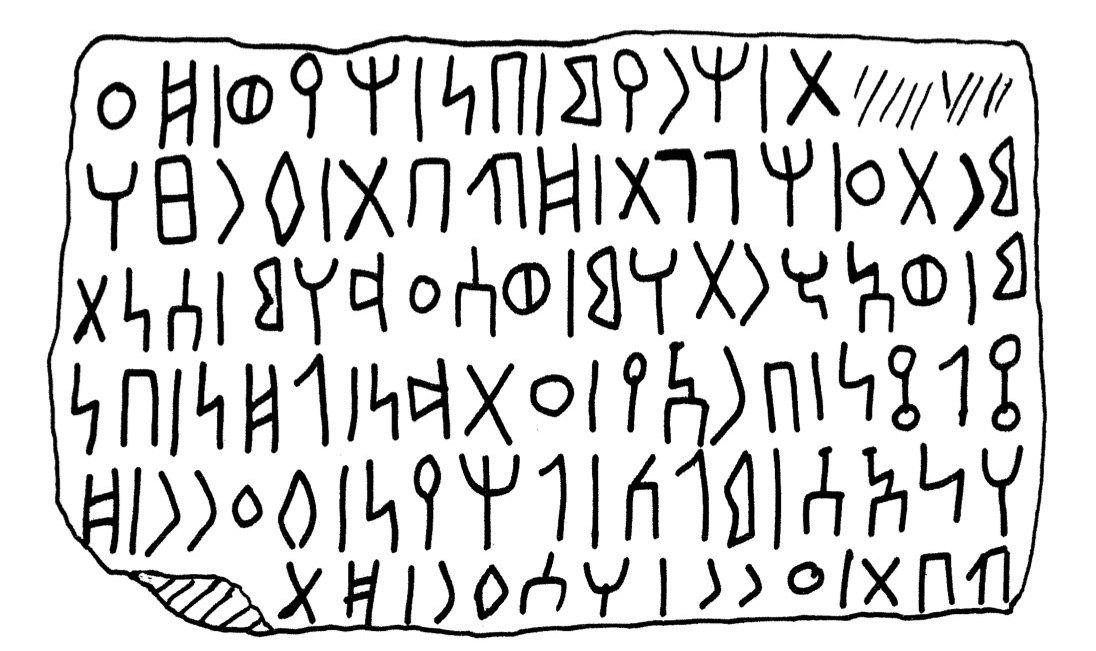
Siglum: AHUD 1 Script: Dadanitic
 /
/


 /
/
 /
/ /
/
 –/
–/ /
/ /
/
 -
- –/
–/ 
 -/
-/ 
 -/
-/ 
 /- /// /
 // –//- /
 Transliteration
1: ----t/ḥrym/bn/ḥyw/ḏ ʿ–
2: mrtʿ/ḥggt/ḏġbt/f rḍ -h–
3: m/w ʾḫrt -hm/w s¹ʿd -hm/s¹nt
4: ṯlṯn/b- rʾy/ʿtdn/lḏn/bn
5: hnʾs¹/mlk/lḥyn/f ʿrr ḏ–
6: ġbt/ʿrr/h- s¹fr/ḏt
Translation
1: ----t Ḥrym son of Ḥyw of the lineage of ʿ–
2: mrtʿ made the pilgrimage [to] Ḏġbt, and so favour
3: them and their posterity and help them in the year
4: thirty of the government of ʿtdn Lḏn son of
5: Hnʾs¹ king of Lḥyn, and so may Ḏ–
6: ġbt dishonour the dishonourer of this inscription
Apparatus Criticus
TRANSLATION
Line 4. ʿtdn, Abū l-Ḥasan: 'the venerable'.
DISCUSSION
Hidalgo-Chacón Díez 2016: 128, for the divine name Ḏġbt.
Commentary
The script is Minaic, but the language and the formulae are Dadanitic.
Lines 1– 2: The verb ḥggt is in the feminine singular of the suffix-conjugation which means that the subject must be a woman. One could therefore suggest that the first legible letter in line 1, t, belonged to the word bnt and that either this was preceded by a very short name of a maximum of two letters, or that a line is missing above it which contained the earlier letters of the name, and possibly another name and genealogy. This second possibility is supported by the plural pronominal suffixes in the prayer f rḍ -hm w ʾḫrt -hm w s¹ʿd -hm, which, however, are in conflict with the feminine singular verb ḥggt. In addition, the relative pronoun ḏ before the lineage name is masculine and, grammatically at least, must refer to the grandfather ḥyw rather than to the woman who is the subject of ḥggt. It is difficult to explain all these anomalies.
The group name ʿmrtʿ occurs many times in the Minaic and Dadanitic inscriptions from al-ʿUlā, see for example JSMin 11/6, 69, 86, 94, etc. and JSLih 245, 276, 281, 288, U 72.
Lines 2–3. For the formula f rḍ -hm w ʾḫrt -hm w s¹ʿd -hm cf. AH 197/7, and for the same formula with the singular enclitic pronoun cf. U 029/4–6, AH 003/6–8 and AH 009/3–4.
Lines 2–5. Similarly formula occurs in JSLih 082, JSLih 083.
Lines 5–6. For the formula ʿrr ḏġbt ʿrr h- s¹fr ḏt cf. HE 01/4–6, JSLih 269/3–4, JSLih 276. In these inscriptions however the masculine Dadanitic demonstrative of nearer deixis, dh, is used rather than ḏt. Another example of the gender chaos in this inscription.
Subjects
Genealogy
Religion
Prayer
Deity
Date (s1nt)
Curse
Country: Saudi Arabia
Region: Al-Madīnah
Site: Oasis of al-ʿUlā
Latitude: 26.616667
Longitude: 37.916667
Present Location: In situ
Notes: Ǧabal Umm Daraǧ
References:
[AHUD] Abū ʾl-Ḥasan Ḥ.ʿA.D. Analysis of a New Minaean Inscription from Al-ʿUla. Adumatu 12, 2005: 29-38 [Arabic].
[AH] Abū ʾl-Ḥasan, Ḥ.ʿA.D. Qirāʾah li-kitābāt liḥyāniyyah min ǧabal ʿakmah bi-minṭaqat al-ʿulā. Al-Riyāḍ: Maktabat al-malik fahd al-waṭaniyyah, 1997.
Hidalgo-Chacón Díez. M. del C. The divine names at Dadan: a philological approach. Proceedings of the Seminar for Arabian Studies 46, 2016: 125–136 Pages: 128
[JSLih, JSMin] Jaussen, A. & Savignac, M.R. Mission archéologique en Arabie. I. (Mars-Mai 1907) De Jérusalem au Hedjaz, Médain Saleh. II. El-ʿEla, d'Hégra à Teima Harrah de Tebouk. Texte et Atlas. III. Les châteaux arabes de Quṣeir ʿAmra, Ḫarâneh, et Tûba. (5 volumes). (Publications de la Société Française des Fouilles Archéologiques, 2). [Reprinted Cairo: Institut Français d'Archéologie Orientale, 1997]. Paris: Leroux/Geuthner, 1909–1920.
URL of this record (for citation): http://krc.orient.ox.ac.uk/ociana/corpus/pages/OCIANA_0047030.html